Quick answer
Most healthy adult dogs need roughly one to two hours of activity a day, working and herding breeds need noticeably more, and puppies and seniors need shorter, gentler sessions. To reduce barking, the type matters as much as the amount: sniffing walks, fetch with rules, nose games and short training sessions drain energy and calm the brain. Exercise takes the edge off boredom barking; for barking that has become a habit, pair it with a consistent cue such as the NooBark smart collar.
Why exercise and barking are connected
Dogs were bred to work: to herd, guard, retrieve, hunt or run alongside people. When a dog with that drive spends most of the day indoors with nothing to do, the energy goes somewhere, and barking at the window, the fence or you is an easy outlet. The ASPCA’s barking guide is direct about it: for a dog that is left alone for long periods, you should increase exercise, mental stimulation and social contact. UK charity PDSA adds that regular exercise is important not only for a dog’s shape but for its mental health.
What exercise does not do is erase a learned habit. If barking has been earning attention, treats or an open door for months, a longer walk will make it a bit quieter, not gone. That is why exercise works best as the foundation, with training and a consistent response on top (here is how to keep dog training consistent when life gets busy).
How much exercise does a dog need?
There is no single number, and PDSA explains why: the right amount depends on breed, age and health. It notes that some breeds need a minimum of one to two hours of exercise a day and that working breeds need significantly more. Use this as a starting point, then adjust to your dog and ask your vet if you are unsure.
| Your dog | Typical daily activity | Barking tip |
|---|---|---|
| Puppy | Several short play and sniff sessions; build up slowly to protect growing joints | Short training games and naps prevent overtired, frustrated barking |
| Adult, companion or toy breed | Around 1 hour, split into walks and play | Add 10 minutes of nose games on busy days |
| Adult, working, herding or sporting breed | 2 hours or more, with real “jobs” | These dogs bark most when bored; mental work is essential |
| Senior | A little less, gentler and more often | Sudden new barking deserves a vet check first |
| Flat-faced or with joint issues | Short, easy sessions; avoid heat | Lean on sniffing and puzzles instead of running |
5 activities that calm a barky dog (and how to do them right)
1. The sniff walk
Why it works: Sniffing is hard mental work for a dog. A slow walk where your dog is allowed to investigate often leaves it calmer than a brisk walk on a short leash.
How to do it: Use a longer leash (a 10–15 ft line in open areas), pick a route with grass and bushes, let your dog choose the pace and stop to sniff, and say a cue such as “go sniff” to give permission.
How much: 20–30 minutes, once or twice a day. Common mistake: rushing the dog along so you “cover distance.” Easier version: scatter a handful of kibble in the yard and let your dog find it.
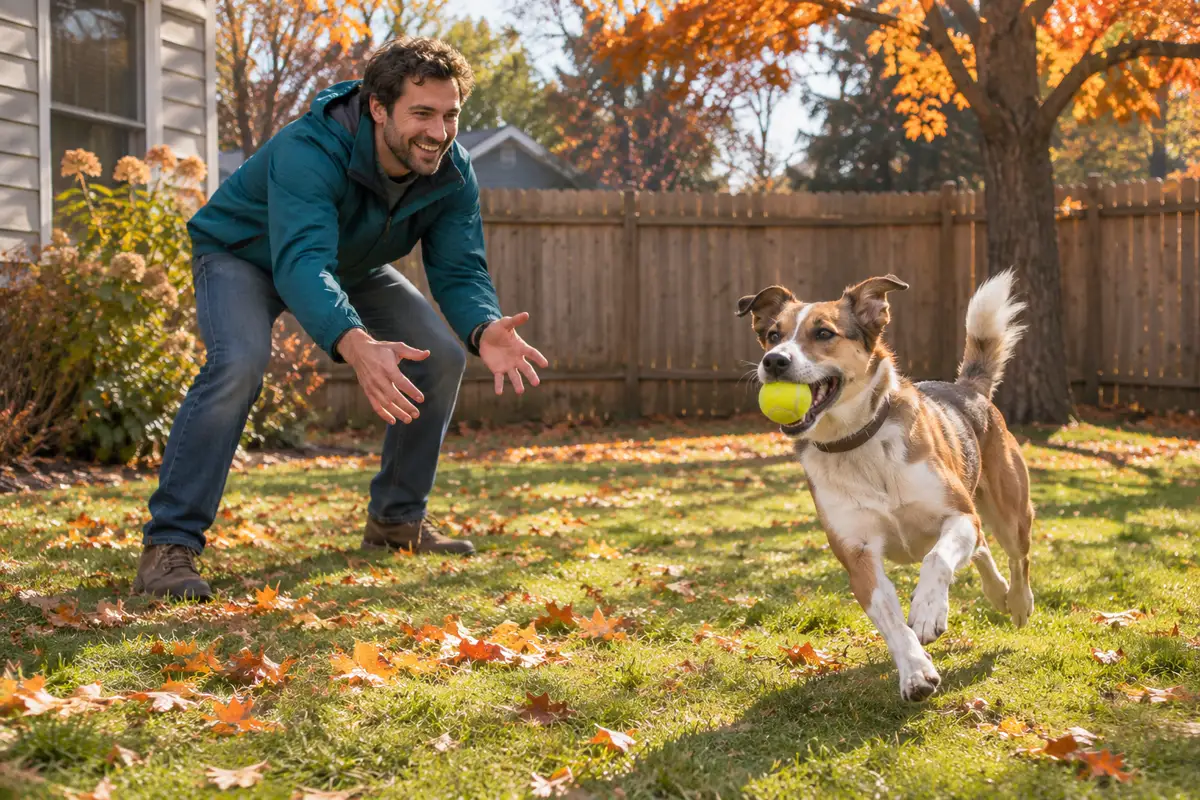
2. Fetch with rules
Why it works: Fetch burns physical energy fast, and adding simple rules turns it into impulse-control practice, which is exactly the skill a barky dog lacks.
How to do it: Ask for a sit before each throw, throw only when your dog is quiet, and end the game with a calm “all done” and a chew, not with a frantic last throw. If your dog barks at you to throw, turn away and wait for a quiet second.
How much: 10–20 minutes, ideally before the time your dog usually barks most. Common mistake: throwing every time the dog barks for the ball, which teaches demand barking (see why does my dog bark at me?). Easier version: short rolls down a hallway for small or older dogs.
3. “Find it” nose games
Why it works: Searching for food uses a dog’s strongest sense, tires the brain and builds focus, and it works indoors on a rainy evening.
How to do it: Have your dog sit, show a treat, place it in plain sight a few feet away and say “find it.” As your dog gets it, hide treats behind furniture, under cups or in a rolled-up towel.
How much: 5–10 minutes, one to three times a day. Common mistake: making it too hard too soon so the dog gives up and barks in frustration. Easier version: a snuffle mat or food puzzle at mealtime.
4. “Go to your spot” training sessions
Why it works: Short training sessions are exercise for the brain, and this particular one gives your dog something to do instead of barking. The ASPCA recommends teaching a dog to go to a spot and stay there when the doorbell rings, building up the stay gradually.
How to do it: Choose a mat or bed, lure your dog onto it, reward, then ask for a short stay of a few seconds. Slowly add distance, then add the sound of a knock. Vary the difficulty so your dog keeps winning.
How much: 3–5 minutes, two or three times a day. Common mistake: practicing only when the doorbell actually rings. Easier version: start with one-second stays. Our guide to barking at the door takes it step by step.
5. Tug or flirt-pole play with an off switch
Why it works: High-energy breeds need a burst of hard play, and a structured game with clear start and stop cues teaches the dog to calm down on request.
How to do it: Invite play with “take it,” play for 20–30 seconds, then say “drop,” hold a treat to the nose and pause until your dog is calm, then start again. Keep the toy at ground level and movements smooth.
How much: 5–10 minutes. Common mistake: letting play spiral into barking and grabbing. Easier version: gentle tug while seated for small dogs; skip it for dogs with neck or joint problems.
Movement and technique at a glance
| Activity | How | How much |
|---|---|---|
| Sniff walk | Long leash, dog sets the pace, permission to sniff | 20–30 min, 1–2× a day |
| Fetch with rules | Sit before each throw, throw only for quiet | 10–20 min |
| “Find it” | Easy hides first, then harder | 5–10 min, 1–3× a day |
| “Go to your spot” | Mat, short stays, add distance and knocks | 3–5 min, 2–3× a day |
| Tug / flirt pole | Clear “take it” and “drop” pauses | 5–10 min |
Timing is the trick most owners miss: schedule the biggest session just before the usual barking hour, whether that is when you leave for work, when the mail arrives or when the neighbors get home. A few days of a barking diary shows you exactly when that is.
When exercise is not enough
If your dog gets plenty of activity and still barks at every sound, the barking is no longer about energy. It is a habit, a reaction to a specific trigger, or, in some dogs, fear. At that point the missing piece is a response that is the same every single time your dog barks, including when you are not in the room. If the barking is new, comes with pain, limping or confusion, or appears in a senior dog, see your vet first. And if your dog shows fear or aggression, work with a qualified trainer.

Our recommendation: the NooBark smart collar
Exercise empties the tank; consistency changes the habit. That is why we recommend pairing a good daily routine with the NooBark smart anti-bark collar. After the walk and the games, NooBark gives your dog the same gentle cue the moment it barks, every time, so the lesson keeps going while you work, cook or sleep. It is the most practical way to make the calm you built with exercise stick.
- Reacts only to your dog. Waveform detection recognizes your dog’s own bark and ignores the TV, other dogs and household noise.
- Gentle-first modes. Sound, vibration, an optional adjustable static mode and a combination mode, so you choose how mild to go.
- 8 sensitivity levels. Tune it to your dog’s size and your home.
- Built for active dogs. IP67 waterproof, so it handles wet grass, rain and muddy walks.
- Long battery. Around 15 days per 2-hour charge, according to the maker.
Owners rate it 4.8/5 across more than 1,900 reviews, and in our own testing it earned a 4.6/5. Start on sound or vibration and pair it with the five activities above. It is up to 75% off on the official store, with a 30-day money-back guarantee. Read our full NooBark review for the details.
Exercise and barking: FAQ
How much exercise does a dog need a day?
It depends on breed, age and health. UK animal charity PDSA notes that some breeds need a minimum of one to two hours of exercise per day and working breeds need significantly more, while puppies need gentler, shorter sessions and seniors often need a little less. Your vet can give you a number for your own dog.
Will more exercise stop my dog from barking?
It reduces barking that comes from boredom, pent-up energy and frustration, and the ASPCA advises increasing exercise, mental stimulation and social contact for dogs left alone for long periods. It will not fix barking that has been rewarded for months or barking driven by fear, which need training and a consistent response too.
Is mental exercise as good as a walk?
Mental work such as sniffing, food puzzles and short training games tires many dogs surprisingly well and is ideal for rainy days, puppies and seniors. The best routine mixes both: movement for the body and problem-solving for the brain.
When is the best time to exercise a barky dog?
Shortly before the times your dog usually barks most, such as before you leave for work, before the afternoon mail delivery or before the evening when visitors arrive. A dog that has just had a good walk and a sniff session is more likely to rest than to patrol the window.
Can a dog get too much exercise?
Yes. Very long or intense sessions can leave some dogs overstimulated rather than calm, and growing puppies, seniors, flat-faced breeds and dogs with joint problems need gentler, shorter activity. Build up gradually, watch for heavy panting or limping, and avoid hard exercise in heat. Ask your vet if you are unsure.
Want more? Read how to stop barking when your dog is home alone, head back to the NooBark overview or read our NooBark review.