Quick answer
Dogs rarely bark at true “nothing.” They hear higher-pitched and fainter sounds than we do, smell things we can’t and notice movement and reflections we tune out, so most “nothing” barking is a reaction to a hidden trigger, often kept alive by an accidental reward. Find and remove the trigger where you can, reward quiet, and for consistency when you are busy or away use a bark-activated tool that responds only to your dog’s own bark, such as the NooBark smart collar. If it starts suddenly in an older dog, see your vet first.
First, why your dog notices what you don’t
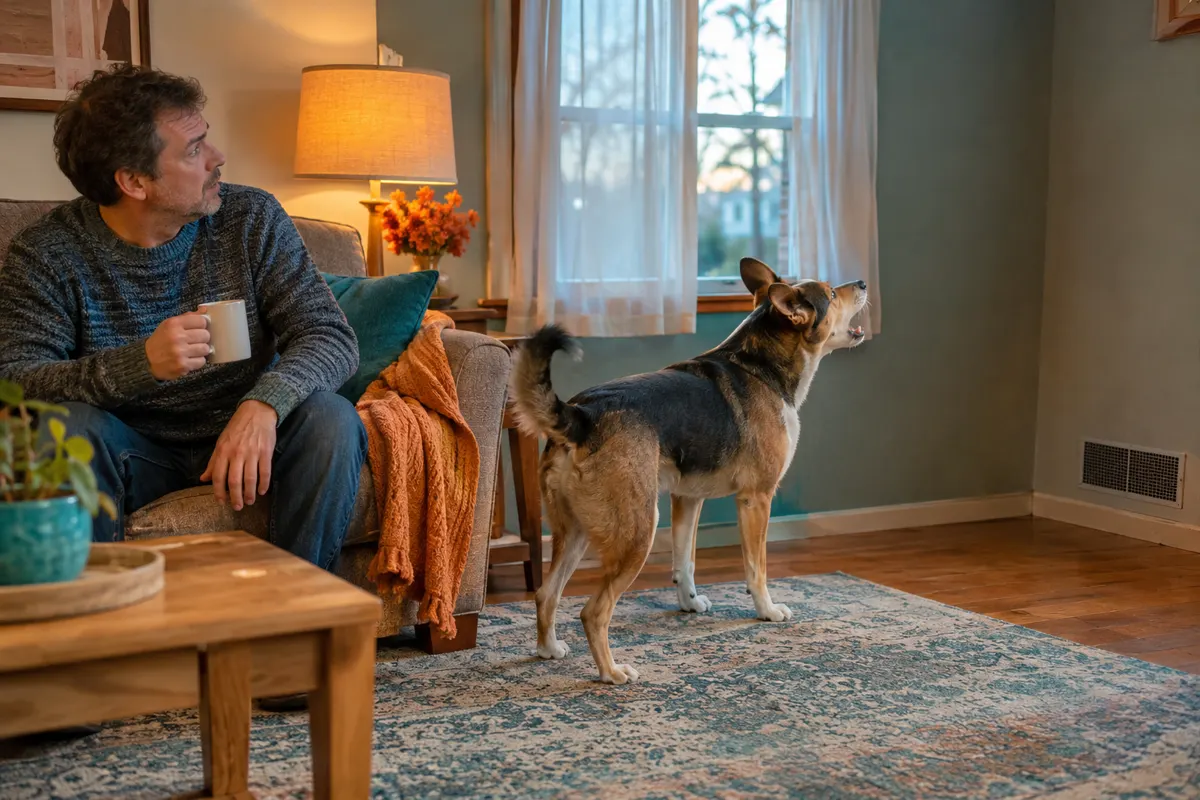
The American Kennel Club’s article on why dogs bark at nothing makes the key point: what looks like nothing to us is usually a real stimulus to a dog. Dogs hear sounds at much higher frequencies than people and catch faint noises from farther away, their sense of smell is in a different league from ours, and they are tuned to small movements. Add a dog’s natural job of alerting the household, and a quiet room can be full of things to report.
The useful question is not “why is my dog crazy?” but “what is my dog noticing, and what keeps the barking going?” The nine triggers below are the ones owners most often miss.
9 hidden triggers that make barking worse
1. High-pitched electronic sounds
Why it matters: Chargers, old TVs, some LED drivers, a smoke detector chirping for a new battery and especially ultrasonic pest repellers can produce tones that are faint or silent to you and very noticeable to a dog.
How to spot it: The barking is aimed at one outlet, wall or room, and stops when the power is off.
The swap: Unplug devices one at a time for a day each, replace the smoke-alarm battery, and move or remove ultrasonic repellers from rooms your dog uses.
2. Sounds traveling through walls, floors and pipes
Why it matters: The furnace switching on, water running through pipes, the ice maker, a neighbor’s door or elevator, footsteps upstairs. In November the heating runs more and the house is closed up, so these sounds are more frequent.
How to spot it: Barking clusters at the same times of day, often when the heat cycles or neighbors come home.
The swap: A steady background sound (a fan, white noise or soft radio) masks short noises. Move your dog’s bed away from shared walls and the utility closet.
3. Smells drifting in
Why it matters: Wildlife under the deck, a cat on the porch, a neighbor’s dog walking past, food smells through a shared vent. Your dog can smell the visitor long after it is out of sight.
How to spot it: Sniffing at the door gap, vents or floor before the barking starts.
The swap: Seal door gaps with a draft stopper, check under decks and porches for animals, and keep trash and pet food stored tightly outside.
4. Reflections, shadows and headlights
Why it matters: At night a window becomes a mirror, car headlights sweep across the ceiling, a ceiling fan throws moving shadows, and a glossy TV screen shows a “second dog.”
How to spot it: The barking happens after dark, aimed at a window, wall or screen, with your dog staring rather than sniffing.
The swap: Close blinds at dusk, switch on a lamp so the window stops reflecting, and turn the fan or screen off when the barking starts to see if it stops.
5. The accidental reward
Why it matters: This is the trigger that keeps all the others going. When your dog barks at the corner and you look over, talk, get up, open the door or offer a treat to quiet them, the barking pays off. The ASPCA’s guide to barking explains that rewarding barking, even with attention, teaches a dog to bark more.
How to spot it: Your dog barks, then looks at you.
The swap: Calmly check once, then ignore the barking and reward the first few seconds of quiet. Our article on why dogs bark at their owners covers demand barking in detail.
6. Too little exercise on short, cold days
Why it matters: November brings darker evenings, colder walks and more time indoors. A dog with energy left over looks for something to do, and alerting at small noises is something to do.
How to spot it: “Nothing” barking is worse on days with shorter walks or more time alone.
The swap: Add a 10-minute sniff walk (sniffing tires dogs out more than you would expect), a puzzle feeder or a short training game before the evening wind-down.
7. Your own routine and stress
Why it matters: Holiday guests, a new work schedule, packages arriving every day, tension in the house. Dogs read the mood and the schedule; when both are unsettled, they go on alert.
How to spot it: The barking started or got worse when something in the household changed.
The swap: Keep meals, walks and bedtime at the same times, and give your dog a quiet den spot away from the front door during busy weeks.
8. Pain or discomfort
Why it matters: A sore joint, an ear infection or tummy trouble can make a dog restless and more reactive, and the barking looks like it is aimed at nothing.
How to spot it: Changes in how your dog lies down, climbs stairs, eats or shakes its head, alongside the barking.
The swap: Book a vet check. Do not try to train away barking that may be caused by pain.
9. Aging senses and the aging brain
Why it matters: Senior dogs with fading hearing or eyesight can be startled by things they only half-perceive, and canine cognitive dysfunction, an age-related condition that vets diagnose, can cause night-time restlessness, staring at walls and barking at nothing.
How to spot it: An older dog that seems confused, gets stuck in corners, sleeps in the day and paces or barks at night.
The swap: See your vet; there are management options and a predictable routine with night lights and a familiar sleeping spot helps.
Quick check: which trigger is it?
| If the barking… | Most likely trigger | First thing to try |
|---|---|---|
| Is aimed at one outlet, wall or room | Electronic sound | Unplug devices one by one |
| Happens at the same times each day | Heating, pipes, neighbors | White noise, move the dog bed |
| Starts with sniffing at doors or vents | Smells | Draft stopper, check for animals |
| Happens after dark at windows or screens | Reflections and lights | Blinds at dusk, a lamp on |
| Ends with your dog looking at you | Accidental reward | Reward quiet, not barking |
| Is worse on low-activity days | Leftover energy | Sniff walk, puzzle feeder |
| Started suddenly or in a senior dog | Pain, senses or cognition | Vet check first |
Keeping a few days of notes makes this much easier; our dog barking diary shows a simple way to log each episode, and if the barking mostly happens after bedtime, read why dogs bark at night.

Our recommendation: the NooBark smart collar
Removing hidden triggers solves a lot, but you cannot unplug the neighbor’s furnace or stop the wildlife under the deck, and you are not always home to reward the quiet moment. That is where a consistent, instant cue helps, and the NooBark smart anti-bark collar is the one we recommend. It is built for exactly this kind of barking: the cue arrives the moment your dog barks, every time, whether you are on a call, asleep or out of the house, so your dog learns quickly that alert-barking at every faint noise is not needed.
- Reacts only to your dog. Waveform detection recognizes your dog’s own bark and ignores the TV, other dogs and the very noises your dog is reacting to.
- Gentle-first modes. Sound, vibration, an optional adjustable static mode and a combination mode, so you choose how mild to go.
- 8 sensitivity levels. Tune it to your dog and your home.
- Long battery. Around 15 days per 2-hour charge, according to the maker.
- Easy to live with. IP67 waterproof, LED touch display and an adjustable strap for small to large dogs.
Owners rate it 4.8/5 across more than 1,900 reviews, and in our own testing it earned a 4.6/5. Use it together with the trigger fixes above, follow the maker’s guidance on fit and daily wear, and check with your vet first if your dog may be in pain or is a senior with sudden changes. It is up to 75% off on the official store, with a 30-day money-back guarantee. Read our full NooBark review for the details.
Barking at nothing: FAQ
Why does my dog bark at nothing?
Almost always, your dog is reacting to something you cannot perceive: a high-pitched sound from electronics, noise traveling through walls or pipes, a scent drifting in, a reflection or shadow, or a habit that has been rewarded by accident. Less often it is boredom, anxiety, pain or age-related changes in hearing, vision or thinking.
Can dogs hear things humans can’t?
Yes. Dogs hear much higher frequencies than people and pick up faint sounds from farther away, so the whine of a charger, an ultrasonic pest repeller, a smoke-alarm chirp or a neighbor’s appliance can be loud and clear to them while the room seems silent to you.
Why does my dog bark at nothing at night?
At night the house is quiet, so small sounds stand out: the furnace kicking on, pipes, wildlife outside, car headlights sweeping across a wall. Lack of exercise during short winter days and, in senior dogs, changes in hearing, vision or cognition can also play a part.
When should I worry about my dog barking at nothing?
See your vet if the barking starts suddenly, especially in an older dog, or comes with confusion, pacing at night, staring at walls, trembling, signs of pain or changes in appetite. Medical causes should be ruled out before you treat it as a training issue.
Should I tell my dog off for barking at nothing?
No. Shouting adds energy and can sound to your dog like you are barking too, and punishment can increase anxiety. Calmly check the area, interrupt, and reward the moment your dog is quiet. A consistent cue at the moment of the bark, such as a bark-activated collar on a sound or vibration setting, can help when you cannot be there.
Will a bark collar react to sounds my dog barks at?
A collar with bark recognition, such as NooBark’s waveform detection, responds only to your own dog’s bark, not to the noise your dog is reacting to, other dogs or the TV.
Want the bigger picture? Read how to set up your home to reduce barking, head back to the NooBark overview or read our NooBark review.