Quick answer
An e-collar (electronic collar) is a general name for a dog collar with an electronic receiver; in training it usually means a remote collar that you trigger with a handheld transmitter. A “shock collar” is the everyday name for a collar that delivers static stimulation. A bark collar is different: it has no remote and reacts automatically to your dog’s bark. A vibration collar uses vibration only. And at the vet, an “e-collar” is the plastic cone. For barking, a gentle-first bark collar like the NooBark is the one we recommend.

“What is an e-collar?” is one of the most common questions dog owners type into Google, and it is easy to see why. The same word is used by trainers for remote training collars, by shoppers as a polite word for shock collars, and by veterinarians for the cone a dog wears after surgery. Add bark collars and vibration collars to the mix and it is no surprise that people buy the wrong tool. Let’s clear it up.
The five “collars” people mix up
| Name | What it is | Who triggers it | Typical use |
|---|---|---|---|
| E-collar (remote training collar) | Collar with an electronic receiver, controlled by a handheld remote | The owner, by pressing a button | Recall and off-leash training, often outdoors |
| “Shock collar” | Everyday name for a collar that delivers static stimulation | Owner (remote) or automatic, depending on the model | Term used for any collar with a static mode |
| Bark collar | Automatic collar that responds to barking | The dog’s own bark, no remote | Excessive or nuisance barking |
| Vibration collar | Collar that uses vibration (and often a tone) only | Owner or automatic | Gentle cue; often used with deaf dogs |
| E-collar cone (Elizabethan collar) | Plastic or soft cone around the head | Nobody: it is not electronic | Stops licking or scratching a wound after surgery |
What an e-collar is (in training)
Among trainers, “e-collar” usually means a remote training collar: a receiver on the collar and a handheld transmitter in the owner’s hand. Many models offer a tone, vibration and adjustable static levels, and the owner chooses when to use them, typically to reinforce a recall or a “leave it” at a distance. The key point is that a person decides when the collar activates. That makes it a training tool that depends heavily on the handler’s timing and skill.
Why people say “shock collar”
“Shock collar” is not a product category so much as a nickname for any collar with a static stimulation mode, remote or automatic. Manufacturers prefer terms like “static,” “stimulation” or “e-collar,” and owners searching online use “shock collar.” If you want the full picture on the welfare debate, our article are bark collars cruel? myths vs. facts covers it honestly.
What a bark collar is (and why it is not an e-collar)
A bark collar solves one specific problem: barking. There is no remote and no one has to be watching. A sensor detects your dog’s bark and the collar responds right away with a cue, every time, with perfect timing. Modern bark collars, like the NooBark, start with sound and vibration and only use an optional, adjustable static mode if the owner chooses it. The better ones use bark recognition, so they react to your own dog’s bark and not to another dog, the TV or a door slamming. Here is a deeper look at how anti-bark collars work.
What a vibration collar is
A vibration collar uses a buzz, similar to a phone on silent, sometimes with a short beep. Many owners choose vibration as their main or only setting, and vibration collars are often used to get the attention of deaf dogs. Many bark collars include a vibration mode, so you do not always need a separate device.
And the “e-collar” at the vet?
If your vet says your dog needs an e-collar after surgery, they mean an Elizabethan collar: the cone (or a soft, inflatable version) that stops a dog licking stitches or a hot spot. It has nothing electronic about it. This is one of the most common search mix-ups, so if you came here looking for the cone, follow your vet’s instructions on how long to keep it on. Another tool people sometimes reach for is a muzzle, but that has a different job too: see will a muzzle stop a dog from barking?
Which one fits your problem?
- My dog barks too muchA bark collar is the tool designed for this. Start with sound and vibration. If you are not sure it fits your dog, try our 10-question self-check.
- My dog ignores recall off-leashThat is a training job; a qualified trainer is the best first step, whatever tool you consider.
- My dog is deafA vibration cue paired with rewards is a common approach; ask your vet or trainer.
- My dog had surgeryYou need the cone (Elizabethan collar), not an electronic collar.
- My dog barks from fear or painSee your vet first. A collar is not the answer to fear, anxiety or a medical cause; our list of questions to ask your vet about barking helps.
Gentle first, whatever you choose
Veterinary behavior organizations generally recommend reward-based training as the foundation, and that is good advice with any collar. Pair the collar with praise and treats for quiet behavior, use the mildest setting that works, fit it correctly (here is how tight a bark collar should be), take it off at night and check the skin daily.
Our recommendation: the NooBark smart collar
If barking is the problem, you do not need a remote e-collar and you do not need to guess at timing. The NooBark smart anti-bark collar is the one we recommend: it is built only for barking, reacts automatically to your own dog’s bark, and lets you start with the gentlest cues.
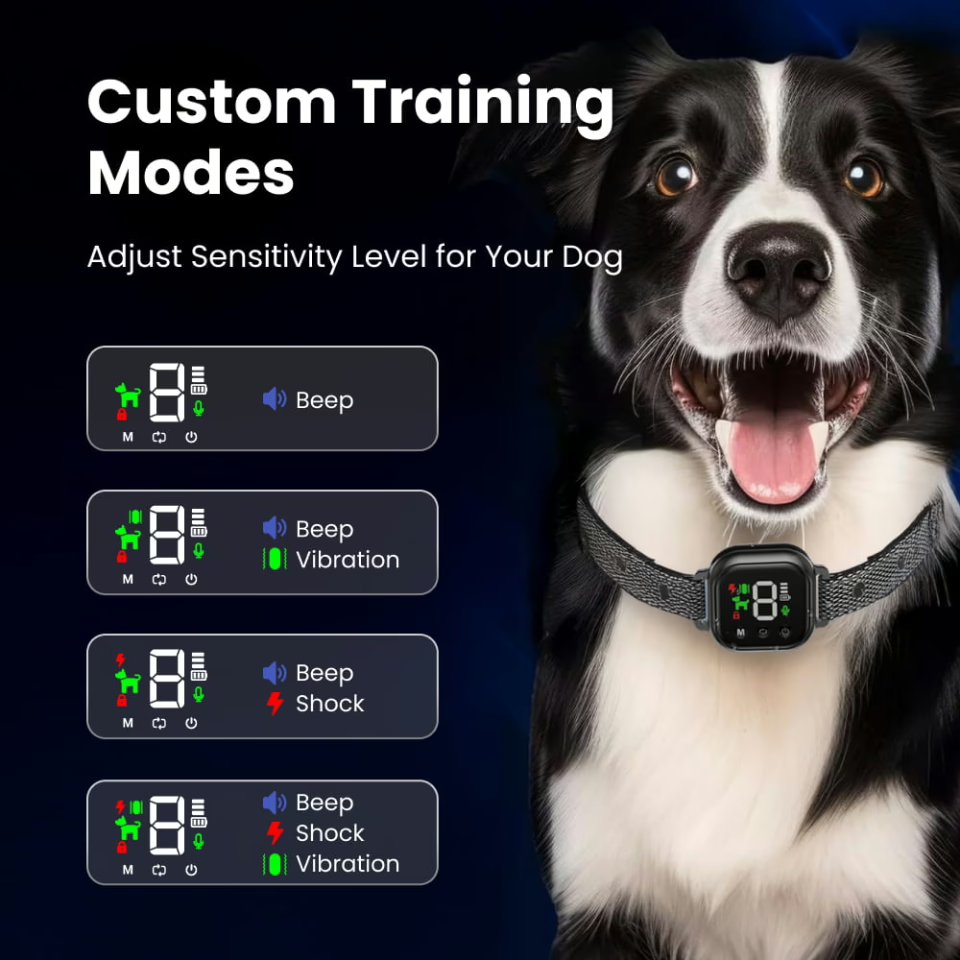
- Gentle-first modes. Sound, vibration, an optional adjustable static mode and a combination mode, so you choose how mild to go.
- 8 sensitivity levels. Fine-tune it to your dog and your home.
- Reacts only to your dog. Waveform detection recognizes your dog’s own bark and filters out other dogs, the TV and street noise.
- No remote, perfect timing. It responds the moment your dog barks, even when you are not home.
- Long battery. Around 15 days per 2-hour charge, according to the maker.
- Easy to live with. IP67 waterproof, LED touch display and an adjustable strap for small to large dogs.
Owners rate it 4.8/5 across more than 1,900 reviews, and in our own testing it earned a 4.6/5. Follow the maker’s guidance on age, size, fit and daily wear, and check with your vet if your dog has any health concerns. It is up to 75% off on the official store, with a 30-day money-back guarantee.
E-collars and bark collars: FAQ
What is an e-collar for dogs?
E-collar is short for electronic collar. In dog training it usually means a remote training collar: a receiver on the collar controlled by a handheld transmitter, with settings such as tone, vibration and adjustable static stimulation. The owner decides when it activates.
Is an e-collar the same as a shock collar?
Often, people use the words for the same kind of device. “Shock collar” is the everyday name for any collar with a static stimulation mode, while “e-collar” is the term trainers and manufacturers prefer. Many e-collars also offer tone and vibration settings.
What is the difference between an e-collar and a bark collar?
An e-collar is triggered by the owner with a remote and is used for general training. A bark collar has no remote: it reacts automatically to the dog’s bark and is designed only to reduce excessive barking. Many bark collars start with sound and vibration, with static as an optional setting.
Is a vibration collar better than a static collar?
Many owners prefer to start with vibration because it is a gentle cue, and it works well for many dogs. Every dog is different, so begin with the mildest setting that gets your dog’s attention, pair it with rewards and ask your vet or a trainer if you are unsure.
What is an e-collar at the vet?
At the vet, an e-collar is an Elizabethan collar: the plastic or soft cone a dog wears around the head after surgery or for a wound, so it cannot lick or scratch the area. It is not electronic.
Can I use a bark collar instead of an e-collar for training?
A bark collar is designed for one job, barking, and it works automatically. It is not meant for teaching recall or other commands. For general obedience, reward-based training and a qualified trainer are the best place to start.
Want to keep reading? See why your dog barks so much, visit the NooBark overview or read our complete NooBark review.