Quick answer
A bark collar is a good fit when your dog is healthy and settled but barks out of habit (at the window, the door, the fence, passersby, or for attention), the barking is causing real problems, and you want a consistent cue even when you're not home. It's not the first step when barking comes from fear or separation distress, starts suddenly, comes with signs of illness, or involves a very young puppy: talk to your vet or a qualified trainer first. If your dog fits the first group, a gentle-first smart collar like NooBark, which starts with sound and vibration and reacts only to your dog's own bark, is the option we recommend.
Bark collars get strong reactions. Some people swear they gave them their evenings (and their neighbors) back; others feel uneasy about the whole idea. Both reactions usually come from the same place: a collar is a great tool for the right dog and the right kind of barking, and the wrong tool for the wrong one. The trick is knowing which one you have. That's what this guide is for.
Step 1: why is your dog barking?
Dogs bark for different reasons, and the reason matters more than the volume. Here's a quick map (for a deeper look, see why does my dog bark so much?):
| Type of barking | What it looks like | Is a collar a good fit? |
|---|---|---|
| Alert / territorial | Barks at the doorbell, window, fence, delivery drivers | Yes, one of the best fits |
| Habit / boredom | Barks at nothing in particular, often when understimulated | Yes, alongside more exercise and enrichment |
| Demand / attention | Barks at you for food, play or to be let out | Yes, combined with ignoring demands and rewarding quiet |
| Reactive to other dogs or noises | Barks at dogs on TV, sirens, the neighbor's dog | Often yes, if the collar reacts only to your dog's bark |
| Fear or separation distress | Barks plus pacing, drooling, trembling, chewing doors | Not as a first step: see a vet or trainer |
| Sudden change or pain | New barking or whining, especially in an older dog | No: see your vet first |
Step 2: the 10-question self-check
Answer yes or no for your dog:
- Is your dog healthy, with no new pain, illness or sudden change in behavior?Sudden barking or whining can be a sign something hurts. Rule that out first.
- Is your dog past the young-puppy stage?For very young puppies, start with training and routine, and check the maker's minimum age and size guidance.
- Does the barking happen at predictable triggers?Doorbell, window, fence, passersby, other dogs: predictable triggers are a sign of habit barking.
- Is your dog relaxed when you leave the house?If you see pacing, drooling, destruction or escape attempts, that points to separation distress instead.
- Does your dog get daily exercise and something to do?A tired, busy dog barks less. A collar works best on top of the basics, not instead of them.
- Have you tried blocking triggers and rewarding quiet?Window film, closed curtains and treats for silence help, and they make any collar work faster.
- Is the barking causing real problems?Neighbor complaints, a landlord warning, a baby who can't nap, your own sleep.
- Does a lot of it happen when you're not there to respond?This is where a collar shines: it gives the same cue every time, even while you're at work.
- Is your dog non-aggressive toward people and other dogs?Aggression needs a professional plan, not just a barking tool.
- Are you willing to start on the gentlest setting and follow the instructions?Sound or vibration first, a correctly fitted strap, and breaks from wearing it.
Mostly yes, especially to 1, 2, 4 and 9? Your dog is a good candidate for a gentle-first bark collar. A no to 1, 2, 4 or 9? Talk to your veterinarian or a qualified trainer first; that's the kind, responsible next step, and many of these dogs can use a collar later as part of a bigger plan.
Who benefits most
- Owners in apartments, condos and close neighborhoods — where every bark carries and complaints come quickly (here's what to do when a neighbor complains).
- Busy owners who work away from home — barking that happens while you're out is the hardest to train by yourself.
- Watchdog personalities — terriers, herders and other alert breeds that announce every leaf and every footstep.
- Families with babies or shift workers — when quiet hours really matter.
- Owners who already tried the basics — exercise, enrichment and rewards helped, but not enough.
What to try first (or alongside)
A collar works best as part of a simple plan, not as the whole plan:
- Exercise and enrichment — a long walk and a puzzle feeder before you leave.
- Block the view — frosted film or closed curtains on the window your dog guards.
- Reward quiet — mark and treat the moments your dog notices a trigger and stays calm.
- Don't reward demand barking — wait for a quiet moment before you open the door or fill the bowl.
- Consistency — the same response every time, which is exactly what a smart collar adds when you're not around.
Curious about what a modern collar actually does on your dog's neck? Our explainer on how anti-bark collars work covers the modes, and are bark collars cruel? takes on the common worries one by one.
What to look for if your dog is a good fit
If the self-check says yes, the collar itself makes a big difference. Look for gentle-first modes (sound and vibration), adjustable sensitivity, detection that reacts only to your dog's bark (so it doesn't trigger on other dogs or the TV), a waterproof build for the yard and a battery that lasts. That's the checklist the NooBark smart collar was built around.

Our recommendation: the NooBark smart collar
If your dog passed the self-check, the NooBark smart anti-bark collar is the collar we recommend. It's designed for exactly the dogs this guide describes, healthy dogs with habit barking, and it starts with the gentlest options:
- Gentle-first modes. Sound, vibration, an optional adjustable static mode and a combination mode. Start with sound or vibration; many dogs never need more.
- It reacts only to your dog. Waveform detection recognizes your own dog's bark and filters out other dogs, TV and street noise, so the cue always matches what your dog did.
- 8 sensitivity levels. Catch real nuisance barking without overreacting to a single woof.
- Works while you're out. The same calm cue every time, which is how habits change.
- Made for everyday life. Adjustable strap for all dog sizes, IP67 waterproof, around 15 days of battery per 2-hour charge and a simple LED touch display.
- Risk-free to try. Up to 75% off on the official store and a 30-day money-back guarantee.
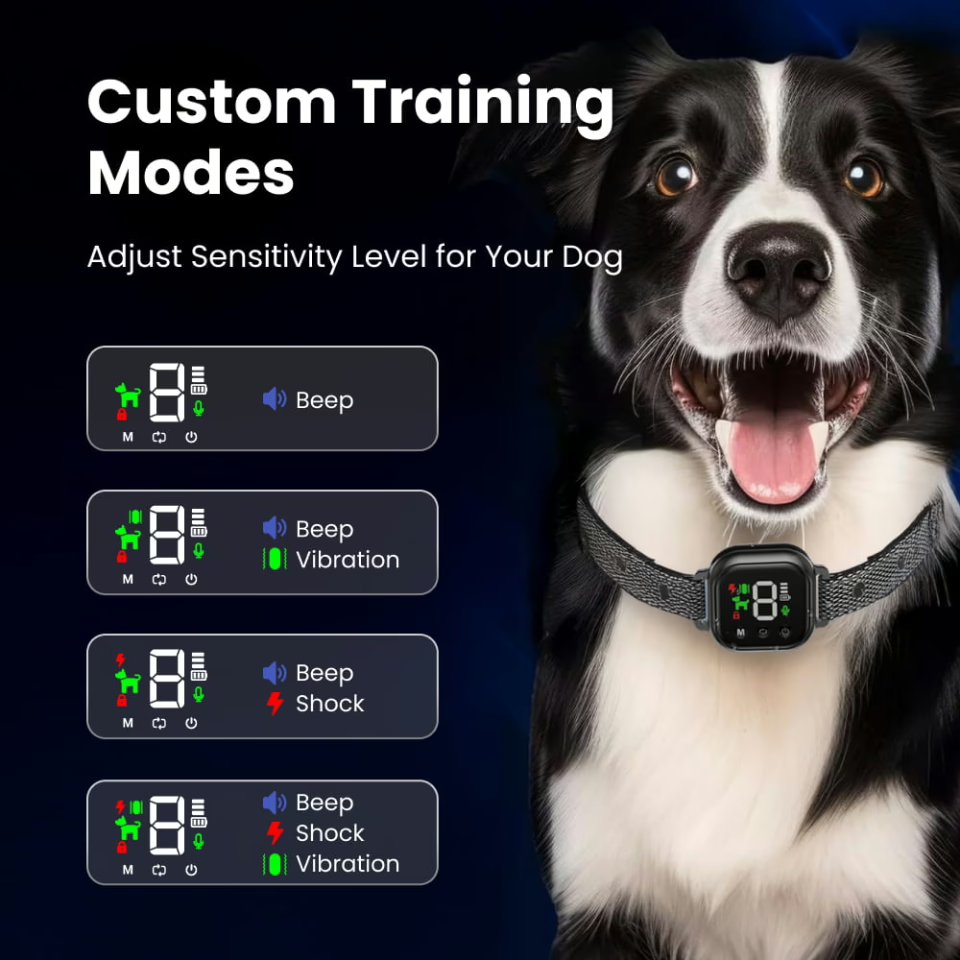

Owners rate it 4.8/5 across more than 1,900 reviews, and in our own testing it earned a 4.6/5. It was created with input from trainer Jordan Hayes and is built around the idea that the kindest correction is the smallest one that works. Many owners see a clear drop in barking within the first couple of weeks (here's what to expect week by week).
Is a bark collar right for my dog? FAQ
How do I know if my dog needs a bark collar?
A bark collar is worth considering when your dog is healthy and settled but barks a lot out of alertness, territorial habit, boredom or demand, the barking is causing real problems at home or with neighbors, and you have already tried the basics such as more exercise, blocking triggers and rewarding quiet. If the barking comes from fear or separation distress, talk to a vet or qualified trainer first.
What kind of barking do bark collars work best for?
Collars work best for habit barking: alert barking at the window or door, territorial barking at the fence, barking at passersby, demand barking and boredom barking. These are learned patterns, and a consistent cue on the first bark helps the dog learn a new, quieter habit.
When should I not use a bark collar?
Skip the collar and speak to your veterinarian or a qualified trainer first if the barking comes with signs of fear or separation distress, such as pacing, drooling, trembling, destruction or trying to escape; if the barking started suddenly or your dog seems unwell or in pain; if your dog is aggressive; or if you have a very young puppy. In those cases the cause needs attention, not just the noise.
Can I use a bark collar on a puppy?
Check the maker's minimum age and size guidance first. For young puppies, most trainers recommend starting with reward-based training, socialization and routine, because a lot of puppy barking fades as they learn. Ask your vet if you are unsure.
Are there bark collars that don't use shock?
Yes. Many modern collars lead with sound and vibration. NooBark offers sound, vibration, an optional adjustable static mode and a combination mode, so you can start with the gentlest setting and many dogs never need more.
Will a bark collar stop all barking?
It is meant to reduce excessive barking, not to silence your dog completely. A good collar with adjustable sensitivity responds to repeated nuisance barking while your dog can still be a dog. Pair it with exercise, enrichment and praise for quiet.
Want to keep reading? See how to stop your dog barking when home alone, visit the NooBark overview or read our complete NooBark review.