Quick answer
A bark collar is not cruel by definition. A collar that leads with a beep or vibration, reacts only to your own dog's bark and is used for short periods alongside training is a gentle interrupter, nothing more. The welfare concerns you read about are real, but they come from strong static shocks, collars that fire on other noises, and owners who use a collar instead of training rather than with it. If you want the humane version, the NooBark smart collar is the one we recommend: sound and vibration first, waveform detection for your dog only, and an optional static mode you can leave off.
We'll be upfront about where we stand. Pets Forever is a gentle-first site: we think barking should be solved with exercise, enrichment, management and rewards, and that a collar is a tool to make the "quiet" cue consistent, not a shortcut around all of that. Several animal-welfare and behavior organizations are critical of aversive tools, particularly electric shock, and they have fair points about misuse. That is exactly why it's worth separating the myths from the facts.
Myth 1: "All bark collars shock the dog"
Fact: most modern collars don't have to shock at all. The term "bark collar" covers five very different tools: beep-only, vibration, citronella spray, ultrasonic and static (shock). Many of the better smart collars put sound and vibration first and make static optional, adjustable, or absent entirely. If the idea of static makes you uncomfortable, you can pick a collar where that mode never gets switched on, and most dogs respond perfectly well to a beep and a buzz. Our guide on how anti-bark collars work walks through each type.
Myth 2: "Vibration is just a softer shock"
Fact: vibration and static are different technologies. A static collar passes a small electric pulse through two contact points on the neck. A vibration collar uses a tiny motor, like the one in your phone, to buzz against the fur. No electricity reaches the dog. It works because it's unexpected and attention-grabbing, not because it hurts. Dogs that have never felt it usually stop mid-bark and look around, and that pause is the opening you use to reward quiet.
Myth 3: "A collar punishes the dog for a normal behavior"
Fact: the goal is to interrupt excessive barking, not to stop a dog from ever making a sound. Barking is normal communication, and a bark or two to say "someone's at the gate" is healthy. The problem owners are trying to solve is the ten-minute session at the window or the all-afternoon fence patrol that leads to noise complaints. A good collar is set up so the gentlest cue interrupts the first bark, your dog pauses, and you take it from there. It's a timing tool, and timing is the thing most of us are bad at.
Myth 4: "Collars make dogs anxious or aggressive"
Fact: harsh, random or badly timed corrections can increase stress; a gentle, predictable cue is a very different experience. This is where the critics have the strongest case, and we agree with it. If a collar zaps a dog because the neighbor's dog barked, or because a truck went by, the dog can't connect the correction to anything it did. That's confusing and unfair, and it can make a nervous dog worse. The fix is twofold: choose a collar that reacts only to your own dog's bark, and never use any collar on a dog whose barking comes from fear or separation distress. Those dogs need a different plan, often with a trainer or vet, and we say so in every guide on this site, including the one on barking when home alone.
Myth 5: "A collar replaces training"
Fact: a collar interrupts; you teach. On its own, a collar only suppresses noise, and critics are right that suppression without teaching is a hollow result. Used well, it's the consistent "hey" that you can't deliver from the shower or from work, followed by the real lesson: calm from you, a reward for staying quiet, more exercise, and fewer triggers to react to. The collar makes the cue the same on bark one every time. Everything else in the routine is still your job, and it's what makes the change stick.
Myth 6: "Any collar off the shelf will do"
Fact: the difference between a humane collar and a harsh one is in the features. Here's the checklist we use:
| Feature | Humane collar | Red flag |
|---|---|---|
| First response | Beep, then vibration | Goes straight to static |
| Bark detection | Recognizes only your dog's bark | Any loud noise sets it off |
| Adjustability | Multiple sensitivity levels | One fixed setting |
| Static mode | Optional, adjustable, can be left off | Always on, no control |
| Fit and build | Light, adjustable strap, waterproof | Heavy, bulky, loose |
| Wearing time | Short sessions, off at night | Worn 24/7 |
| Guarantee | Money-back period to test it at home | No returns |
Myth 7: "If it's humane, it won't work"
Fact: for alarm, territorial and habit barking, a gentle cue works precisely because it's consistent. Dogs don't need pain to learn; they need clarity. A beep that arrives on the first bark, every single time, is far clearer than an owner who sometimes yells, sometimes ignores and sometimes gives in. Combine that with the management steps in our guides on backyard barking and doorbell barking, and most owners see a calmer dog within a few weeks (here's what to expect week by week). Here's what a humane routine looks like in practice:
- Rule out fear and healthSudden barking, pacing, drooling or destruction while you're out points to anxiety or discomfort. Talk to your vet or a trainer before any collar.
- Fix the easy causes firstA longer walk, a food puzzle, closed curtains at the trigger window. Many dogs bark less within days.
- Introduce the collar switched offLet your dog wear it for a day or two with no modes active so it becomes just another collar.
- Start on the gentlest settingBeep or vibration, lowest sensitivity that still catches the bark. Only move up if nothing changes after a fair trial.
- Reward the pauseWhen the cue interrupts the bark, calmly praise or treat the quiet. That's the moment learning happens.
- Use it for sessions, not all dayPut it on for the situations you're working on, take it off at night and during rest, and check the skin under the strap regularly.
Our recommendation: the NooBark smart collar
If you've read this far, you want a collar that passes the humane checklist above, and that's exactly why we recommend the NooBark smart anti-bark collar. It was designed around the gentle-first approach, which makes it the most practical choice for owners who care about doing this kindly:
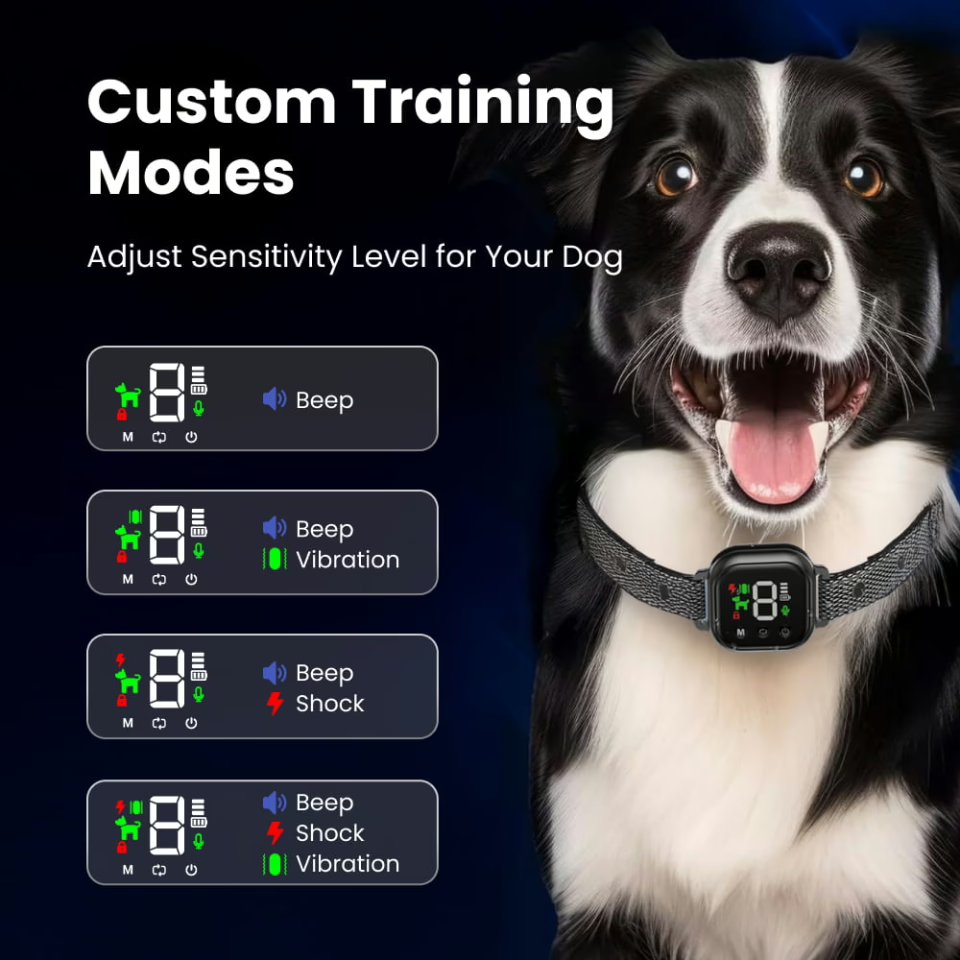
- Sound and vibration come first. Four modes in total: sound, vibration, an optional adjustable static mode, and a combination mode that escalates from gentlest to firmest. You can leave static switched off and never touch it.
- It fires only on your dog. NooBark's waveform detection recognizes your own dog's bark and filters out other dogs, traffic and household noise, so the corrections are always fair and connected to what your dog actually did.
- 8 sensitivity levels. You dial it to the lowest setting that catches the bark, which is exactly what a humane routine calls for.
- Comfortable to live with. Light, adjustable strap for all dog sizes, IP67 waterproof, around 15 days of battery per 2-hour charge and a simple LED touch display.
- Risk-free to test. The official store offers up to 75% off and a 30-day money-back guarantee, so you can judge it on your own dog, in your own home.


Owners rate it 4.8/5 across more than 1,900 reviews, and in our own testing it earned a 4.6/5, with its highest marks for humane design and control. It won't replace a trainer for a fearful dog, and nothing should. But for the everyday alarm and habit barking that most of us are dealing with, it's the gentle, consistent tool we'd choose. Not sure which group your dog is in? Take our 10-question bark collar self-check.
Bark collar FAQ
Are bark collars cruel?
It depends entirely on the collar and how it's used. A collar that leads with a beep or a vibration, reacts only to your own dog's bark and is used alongside training is a gentle interrupter, not a punishment. Collars that go straight to a strong static shock, fire on other noises or are left on a stressed dog all day are where the real welfare problems come from.
Do vibration bark collars hurt dogs?
No. A vibration is a buzz similar to a phone vibrating in your pocket. It surprises the dog and interrupts the bark, but it doesn't cause pain. Most dogs respond to sound and vibration alone, which is why a humane collar should start there.
Is a vibration collar the same as a shock collar?
No. A shock (static) collar delivers an electric pulse through contact points. A vibration collar uses a small motor to buzz against the neck, with no electricity reaching the dog. Some smart collars include both, with the static mode optional and adjustable, so you can simply leave it switched off.
Can bark collars cause anxiety or aggression?
Harsh or badly timed corrections can increase stress, especially in fearful dogs, and no collar should be used on a dog that barks from fear or separation anxiety. A gentle, consistent cue that only fires on the dog's own bark, combined with exercise, enrichment and rewards for quiet, is a very different experience from a random shock.
Do bark collars actually teach a dog anything?
A collar interrupts the bark; you do the teaching. When the interruption is followed by calm from you and a reward for quiet, your dog learns that stopping quickly pays. Used on its own, with no training around it, a collar only suppresses noise, which is why we always recommend pairing it with a simple routine.
How long should a dog wear a bark collar each day?
Only during the situations you're working on, typically a few hours a day, and never 24/7. Take it off at night and during rest, check the skin under the contact area regularly, and make sure the strap is snug but not tight.
Want the full picture on the collar? Visit the NooBark overview or read our complete NooBark review.