Quick answer
The mistakes that make barking worse are almost always about timing and consistency: yelling (which sounds like joining in), accidentally rewarding the bark with attention or the open door, correcting too late, different family members following different rules, and harsh punishment that makes a dog more anxious. The fix is a calm, consistent cue on the first bark, every time, plus praise for quiet and enough exercise. A gentle-first smart collar like NooBark handles the timing and consistency part for you, even when you're not home.
Dogs bark for good reasons: to alert, to guard, to ask for something, to release energy. Barking itself isn't the problem. The problem is when it becomes a habit that goes on too long, too loud, too often. And habits are learned, which means they can be unlearned. The catch is that dogs learn from what actually happens after they bark, not from what we intend. That's why well-meaning owners so often make it worse. If you want the background on why dogs bark in the first place, start with why does my dog bark so much.
Mistake 1: Yelling "quiet!" or "no!"
Why it backfires: to many dogs, a raised voice sounds like you're joining in. You've just turned a bark at the mail carrier into a group effort. It also adds tension and excitement, which fuels more barking.
The fix: stay calm and quiet yourself. Use one low, neutral cue, then reward the moment your dog stops, even for two seconds. Calm is contagious.
Mistake 2: Rewarding the bark without realizing it
Why it backfires: this is the big one. Your dog barks at the back door and you let him in. He barks at you during dinner and gets a scrap to keep him quiet. He barks at the ball and you throw it. Every one of those teaches the same lesson: barking works.
The fix: make sure barking never pays. Wait for a moment of quiet before opening the door, throwing the ball or giving attention. At first the barking may get a little louder as your dog tests the new rule; that's normal, and it fades if you stay consistent.
Mistake 3: Correcting too late
Why it backfires: by the tenth bark, your dog is in full alarm mode and can't really hear you. A cue that arrives late doesn't connect with the start of the behavior, so the dog doesn't learn what it's for.
The fix: interrupt the first bark, not the fifth. That's when your dog can still choose to stop. Then reward the quiet.
Mistake 4: Different rules from different people
Why it backfires: you ignore the barking at the window; your partner shouts at it; the kids think it's funny. Your dog gets three different responses to the same behavior, which is the slowest possible way to learn. Inconsistent cues are one of the most common reasons training stalls.
The fix: agree on one cue and one response as a household, and stick to it. Write it on the fridge if you need to.
Mistake 5: Harsh punishment
Why it backfires: scolding, swatting or scary corrections can leave a dog anxious or confused about you, and an anxious dog often barks more, not less. Many animal-welfare and local-council guides warn that punishing barking tends to make the problem worse.
The fix: keep any interruption mild and predictable, and put most of your effort into rewarding quiet. The kindest correction is the smallest one that works.
Mistake 6: A bored, under-exercised dog
Why it backfires: a dog with pent-up energy will find a way to use it, and barking is easy. No amount of training beats an empty day.
The fix: a good walk, a sniffing game, a chew or a puzzle feeder before the times your dog usually barks. A tired dog barks less.
Mistake 7: Leaving the triggers on display
Why it backfires: a dog parked at the front window all day is rehearsing "bark at everything that moves" hundreds of times. Every rehearsal makes the habit stronger.
The fix: reduce the view while you train: frosted film on low windows, a closed curtain, moving the couch. For specific triggers, see our guides on barking at the door and barking in the backyard.
Mistake 8: Starting with the strongest correction
Why it backfires: owners who jump straight to the firmest setting of any training tool often create a stressed dog, which can make barking worse. It also leaves nowhere to go if you need a little more later.
The fix: start with the gentlest cue that gets your dog's attention, like a sound or a vibration, and only adjust if needed. Most dogs respond to the mildest option when the timing is right.
Mistake 9: Giving up after a few days
Why it backfires: barking habits are well practiced. Many dogs improve within days, then test the new rules in week two. Owners who quit or change plans at that point lose the progress they'd made.
The fix: give any plan a fair few weeks of consistency. Our week-by-week guide on how long a bark collar takes to work shows what normal progress looks like.
One thing that isn't a training mistake
If your dog barks while pacing, drooling, trembling, destroying things or trying to escape when left alone, or if barking started suddenly or your dog seems unwell, that's not a habit problem. Talk to your veterinarian or a qualified trainer first, because the cause needs attention, not just the noise.
Mistakes vs. fixes at a glance
| Mistake | What your dog learns | Do this instead |
|---|---|---|
| Yelling "quiet!" | You're barking too | Calm cue, reward silence |
| Opening the door, throwing the ball | Barking works | Wait for quiet first |
| Correcting late | Nothing connects | Interrupt the first bark |
| Different rules from everyone | The rule is random | One household cue |
| Harsh punishment | The situation is scary | Mild cue, lots of praise |
| Not enough exercise | Barking burns energy | Walks, sniffing, puzzles |
| Starting too strong | Training is stressful | Gentlest cue first |
| Quitting in week two | Testing pays off | Stay consistent for weeks |
Why most owners struggle with timing and consistency
Look at the list again and you'll notice something: the hardest fixes are being there for the first bark and responding the same way every single time. That's nearly impossible when you're at work, asleep, cooking or on a call. Your dog's barking at the mail carrier at 11 a.m. doesn't wait for you to come home. That's the gap a smart collar fills. The NooBark gives the same gentle cue on your dog's first bark, every time, whether you're in the room or not.
Our recommendation: the NooBark smart collar
If you've recognized a few of these mistakes, the NooBark smart anti-bark collar is the tool we recommend to fix them. It does the two things owners find hardest, perfect timing and perfect consistency, while starting with the gentlest options:
- Responds to the first bark. The cue arrives at the moment barking starts, which is when dogs actually learn.
- The same cue, every time. No mixed messages from different family members, and it works while you're out.
- It reacts only to your dog. Waveform detection recognizes your dog's own bark and filters out other dogs, TV and street noise, so the cue always matches what your dog did.
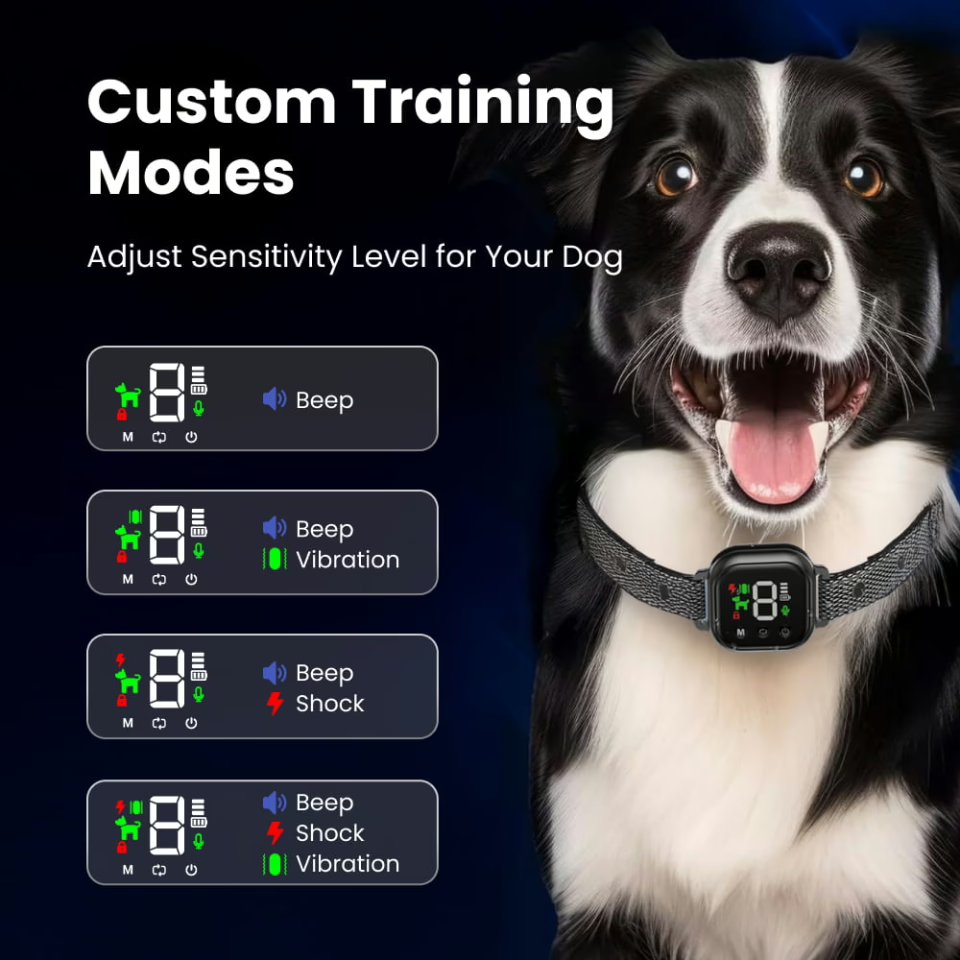
- Gentle-first modes. Sound, vibration, an optional adjustable static mode and a combination mode. Start with sound or vibration; many dogs never need more.
- 8 sensitivity levels. Catch real nuisance barking without reacting to a single woof.
- Made for everyday life. Adjustable strap for all dog sizes, IP67 waterproof, around 15 days of battery per 2-hour charge and a simple LED touch display.

Owners rate it 4.8/5 across more than 1,900 reviews, and in our own testing it earned a 4.6/5. It was created with input from trainer Jordan Hayes and is built around the idea that the kindest correction is the smallest one that works. Pair it with praise for quiet and enough exercise, and you've fixed every mistake on this list. It's up to 75% off on the official store, with a 30-day money-back guarantee.
Barking training mistakes: FAQ
Why does my dog bark more when I yell at him?
To many dogs, a raised voice sounds like you are joining in, or it adds excitement and tension to a situation that is already exciting. Either way the barking tends to continue or get louder. A calm, consistent cue on the first bark, followed by praise for quiet, works much better.
Can you accidentally reward a dog for barking?
Yes, and it is the most common mistake. Opening the door, letting the dog in, throwing the ball, giving a treat to quiet it down or even just looking and talking to it can all reward the bark. The dog learns that barking makes good things happen and barks more.
Is it too late to fix a barking habit in an older dog?
No. Adult and older dogs can learn new habits too. It may take longer because the pattern is well practiced, so consistency matters even more. If an older dog starts barking suddenly or differently, see your vet first, since changes can have a medical cause.
Should I punish my dog for barking?
Harsh punishment usually backfires: it can make a dog anxious or confused, which often leads to more barking. What works is a mild, consistent interruption at the moment barking starts, followed by praise and rewards for quiet, plus enough exercise and enrichment.
How long does it take to stop a barking habit?
Many owners notice a change within one to two weeks of consistent training, and well-practiced habits can take three to four weeks or longer. Every dog is different. The fastest results come from the same cue, from everyone, every time.
Does a bark collar help with training mistakes?
A smart collar fixes the two hardest parts of barking training for most owners: timing and consistency. It responds to the first bark, the same way every time, even when nobody is home. Combined with praise for quiet and enough exercise, it helps dogs learn a calmer habit faster.
Want to keep reading? See are bark collars cruel? 7 myths vs. the facts, visit the NooBark overview or read our complete NooBark review.