Quick answer
The best way to start stopping your dog's barking is to use one weekend to set up the whole system: log the triggers on Saturday morning, fix the home in the afternoon, fit a consistent tool and run your first short practice, then rehearse departures and plan the week on Sunday. Barking will not disappear in 48 hours, and nothing honest promises that, but you finish the weekend with a clear picture of why your dog barks and a routine that works on Monday. For the tool part, we recommend the gentle-first NooBark smart collar.
Why a weekend? Because the two biggest reasons barking plans fail are no time and no clear first step. A weekend gives you both: you are home, you can watch your dog in a normal day, and you can do the setup tasks once instead of squeezing them between work calls. Animal-welfare and veterinary sources such as the ASPCA, PetMD and Battersea all start in the same place: understand why your dog barks, manage the environment and reward quiet instead of punishing noise. This plan just puts those steps on a calendar.
Before you begin: if the barking started suddenly, or comes with other changes such as limping, restlessness or changes in appetite, book a vet visit first. Pain or illness can cause barking, and our list of questions to ask your vet about barking helps you prepare.
What you need (gather it Friday night)
- A notebook or phone note for the barking log.
- Small, soft treats your dog loves, cut tiny.
- A long-lasting chew or puzzle feeder.
- White noise: a fan, a white-noise machine or a playlist.
- Window film, a curtain or a baby gate if your dog barks at the window.
- Your bark collar, charged, if you are using one.
Saturday
Saturday morning (9:00–11:00): write down your starting point
Do not fix anything yet. Just watch. Every time your dog barks, write four things: time, place, trigger, how long. Doorbell at 9:40, front window, mail carrier, 2 minutes. This is your baseline, and it is the most useful page you will write all weekend. Our dog barking diary guide has a simple template.
By 11:00 you usually see the pattern: mostly alert barking at the window and door, demand barking at you during meals, or boredom barking in the afternoon. Each pattern points to a different fix below.
Saturday midday (11:00–13:00): a real walk
Take a longer walk than usual, with time to sniff. A dog whose need for exercise and mental work is met has less energy to spend on noise. Note how the afternoon log compares with the morning.
Saturday afternoon (14:00–17:00): set up the house
Now use the log. For each trigger, ask: can I remove it, block it or soften it?
- Window barking: frosted film on the lower glass, close the blinds, move the sofa away from the window.
- Outside noise: white noise in the room where your dog rests.
- Doorbell: a gate between the front door and the living area, and a “go to your bed” spot.
- Boredom: set up a puzzle feeder for the times the log shows boredom barking.
Our room-by-room guide has the full checklist if you want to go further.
Saturday evening (18:00–20:00): introduce the collar calmly
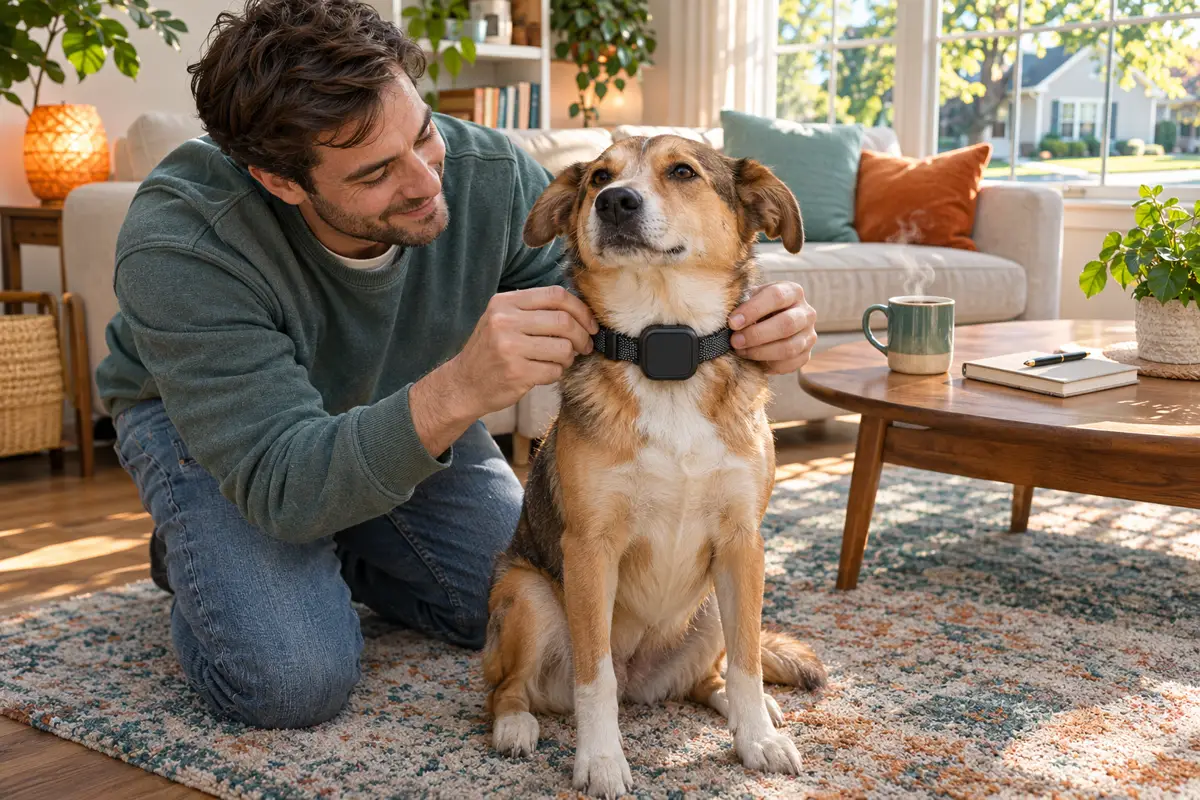
If you use a smart bark collar, Saturday evening is a good time to introduce it while the house is quiet. Let your dog sniff it, then fit it for short periods while you are home, starting at the gentlest mode, such as sound or vibration. Check the fit: snug enough for the unit to stay in place, loose enough for two fingers under the strap. We cover this in detail in how tight a bark collar should be. Pair the first wear with something good, like dinner or a chew.
Sunday
Sunday morning (9:00–11:00): first quiet practice
Run two or three short sessions of five minutes each. When your dog barks, wait for a pause, say your chosen word (“quiet” or “thanks”) in a calm voice, and reward the silence. Never yell: to many dogs it sounds like you are joining in. If you have a helper, have them ring the doorbell once, and practice going to the bed spot. Short and successful beats long and frustrating.
Sunday midday (11:00–13:00): walk, then rest
Another sniff walk, then a calm rest at home with the chew and white noise on. You are teaching your dog what a normal quiet afternoon feels like.
Sunday afternoon (14:00–17:00): rehearse Monday
If barking happens when you leave, practice departures. Pick up your keys, walk out for one minute, come back calmly with no big greeting. Then three minutes. Then ten. If you use a collar, this is when its consistency helps most, because it responds the same way when you are on the other side of the door. If your dog shows real panic when alone, such as destroying the door frame, drooling heavily or trying to escape, stop and talk to your vet or a qualified trainer; our home-alone barking guide explains why.
Sunday evening (18:00–20:00): compare and plan the week
Count the barks in your Sunday log and compare them with Saturday morning. Do not judge the result yet; you are only building the habit of measuring. Then write three daily habits for the week, for example: walk before work, white noise on when you leave, two five-minute quiet sessions in the evening.
The weekend at a glance
| Block | Saturday | Sunday |
|---|---|---|
| Morning | Watch and log every bark (baseline) | First 5-minute quiet sessions |
| Midday | Long sniff walk | Sniff walk, then calm rest |
| Afternoon | Set up the house: block, mask, gate | Rehearse leaving: 1, 3, 10 minutes |
| Evening | Fit and introduce the collar calmly | Compare the logs, plan 3 habits |
What to do on Monday
- Walk before you leaveEven 15 extra minutes helps.
- Set the sceneWhite noise on, blinds closed, chew or puzzle feeder ready.
- Keep the tool consistentSame collar, same gentle mode, following the maker's daily wear guidance.
- Log for five minutes in the eveningWrite down what you saw or what neighbors mentioned.
- Review next weekendAdjust one thing at a time. Progress usually takes several weeks of consistency.
Our recommendation: the NooBark smart collar
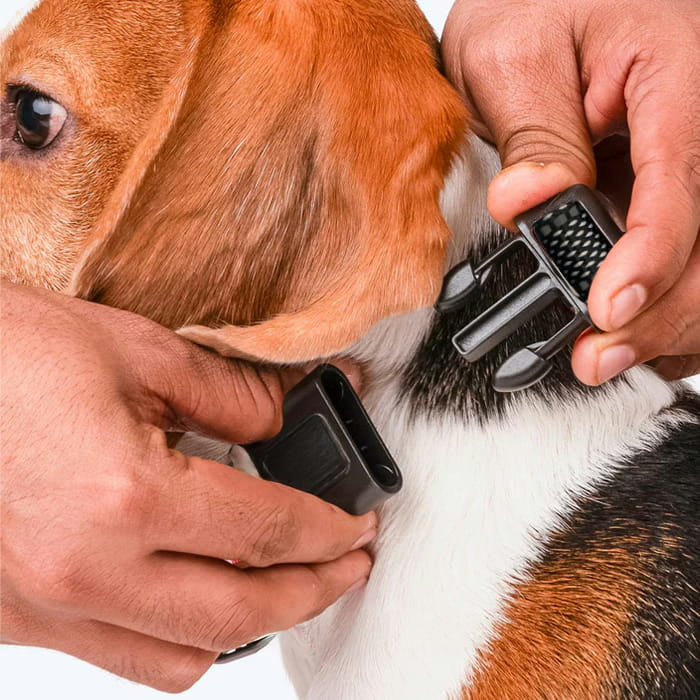
A weekend plan sets the stage, but the hardest part comes on Monday, when you are busy or out and the doorbell still rings. That is where a consistent tool earns its place, and the NooBark smart anti-bark collar is the one we recommend. It gives your dog the same calm feedback at the exact moment of every bark, which no person can do all day, and it starts with the gentlest cues. It is the most practical way to keep your weekend progress going all week.
- Gentle-first modes. Sound, vibration, an optional adjustable static mode and a combination mode, so you choose how mild to go.
- 8 sensitivity levels. Fine-tune it to your dog and your home.
- Reacts only to your dog. Waveform detection recognizes your dog's own bark and filters out other dogs, the TV and street noise.
- Works while you are out. No remote needed, so Monday at the office looks like Saturday at home.
- Long battery. Around 15 days per 2-hour charge, according to the maker.
- Easy to live with. IP67 waterproof, LED touch display and an adjustable strap for small to large dogs.
Owners rate it 4.8/5 across more than 1,900 reviews, and in our own testing it earned a 4.6/5. Follow the maker's guidance on age, size, fit and daily wear, and check with your vet if your dog has any health concerns. It is up to 75% off on the official store, with a 30-day money-back guarantee, so you can start this weekend and judge it over the following weeks.
Weekend plan to stop dog barking: FAQ
Can you stop a dog from barking in one weekend?
Not completely, and no honest plan promises that. What a weekend can do is set everything up: you learn your dog’s triggers, remove the easy ones, put a consistent tool in place and start short training sessions. Most dogs then improve over the following weeks with daily consistency.
What should I do first to stop my dog barking?
Start by watching and writing down when, where and at what your dog barks. That tells you whether you are dealing with alert barking, boredom, demand barking or barking when left alone, and each one needs a slightly different fix.
Should I put a bark collar on my dog the first day?
You can fit it on day one, but introduce it calmly: let your dog sniff it, put it on for short periods while you are home, start at the gentlest mode, such as sound or vibration, and check the fit. Follow the maker’s guidance on fit, age and daily wear time.
How do I stop my dog barking when I leave on Monday?
Use the weekend to practice short departures: leave for a few minutes, come back calmly and gradually build up. Add white noise, block the window view, give a long-lasting chew and make sure your dog had a walk first. If your dog shows signs of real distress when alone, talk to your vet or a qualified trainer.
Is it okay to ignore my dog when it barks?
Ignoring works for demand barking, when your dog barks to get attention, food or play, as long as you reward the quiet moments. It does not work for barking caused by fear, boredom or a real need such as going outside, so check the cause first.
Want to compare methods first? Read 8 ways to stop a dog from barking, ranked, head back to the NooBark overview or read our NooBark review.